Half from the factory. And the street?
The Dutch government wants half of all new homes to be factory-built within four years. We support that fully. With one addition.
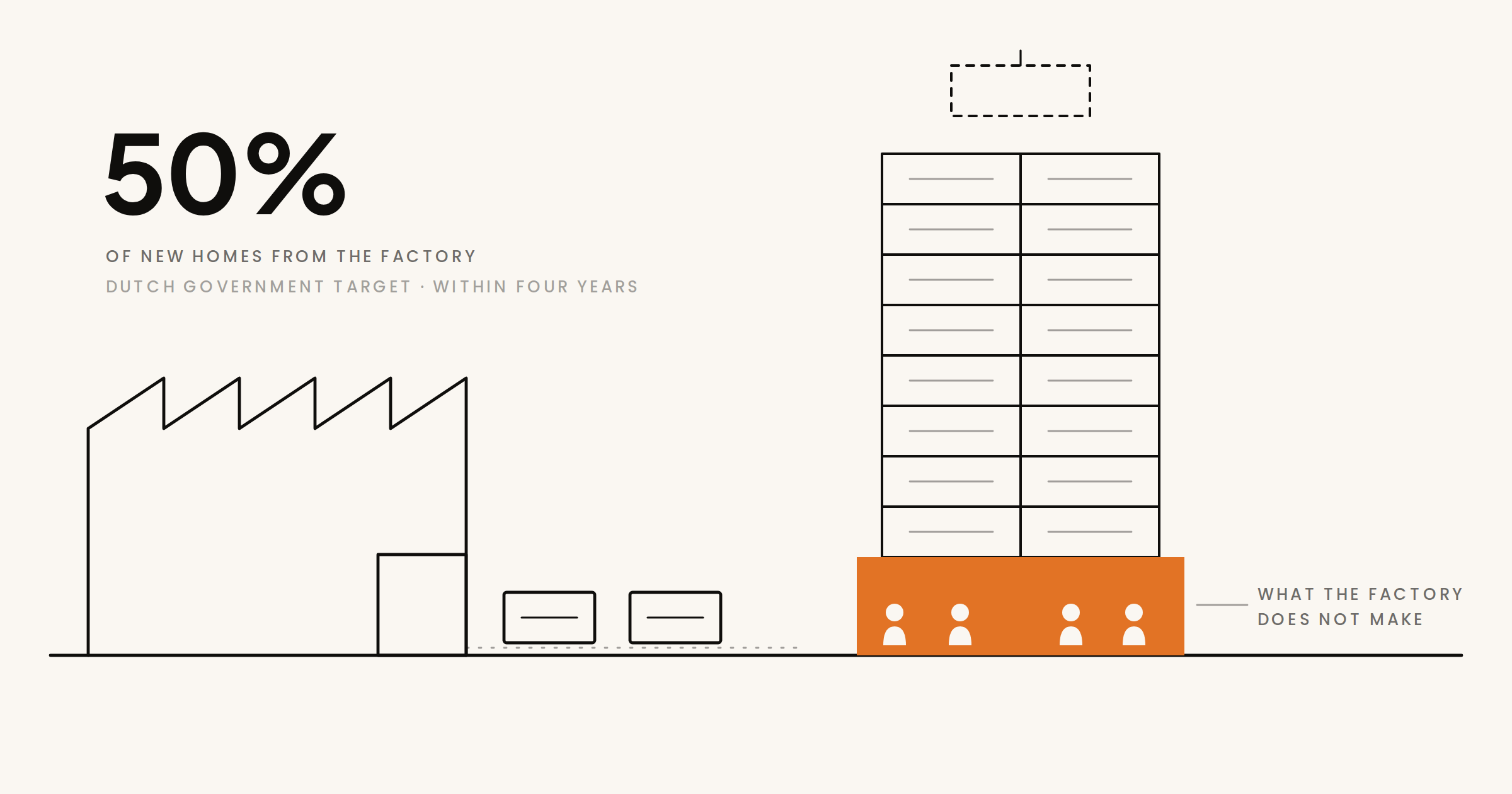
On 20 April the Dutch cabinet set a number the construction sector will be working towards for years. Within four years, at least half of all new homes must come out of a factory. Today it is just over one in five.
It is a logical number. The Netherlands is short 384,000 homes this year, 4.6 percent of the housing stock. From plan to completion, a home currently takes ten years on average. The government wants to halve the design and permitting phase from eight years to four, has set aside 90 million euros for innovation and digitalisation, and is adapting building regulations for certified prefabricated homes.
We agree
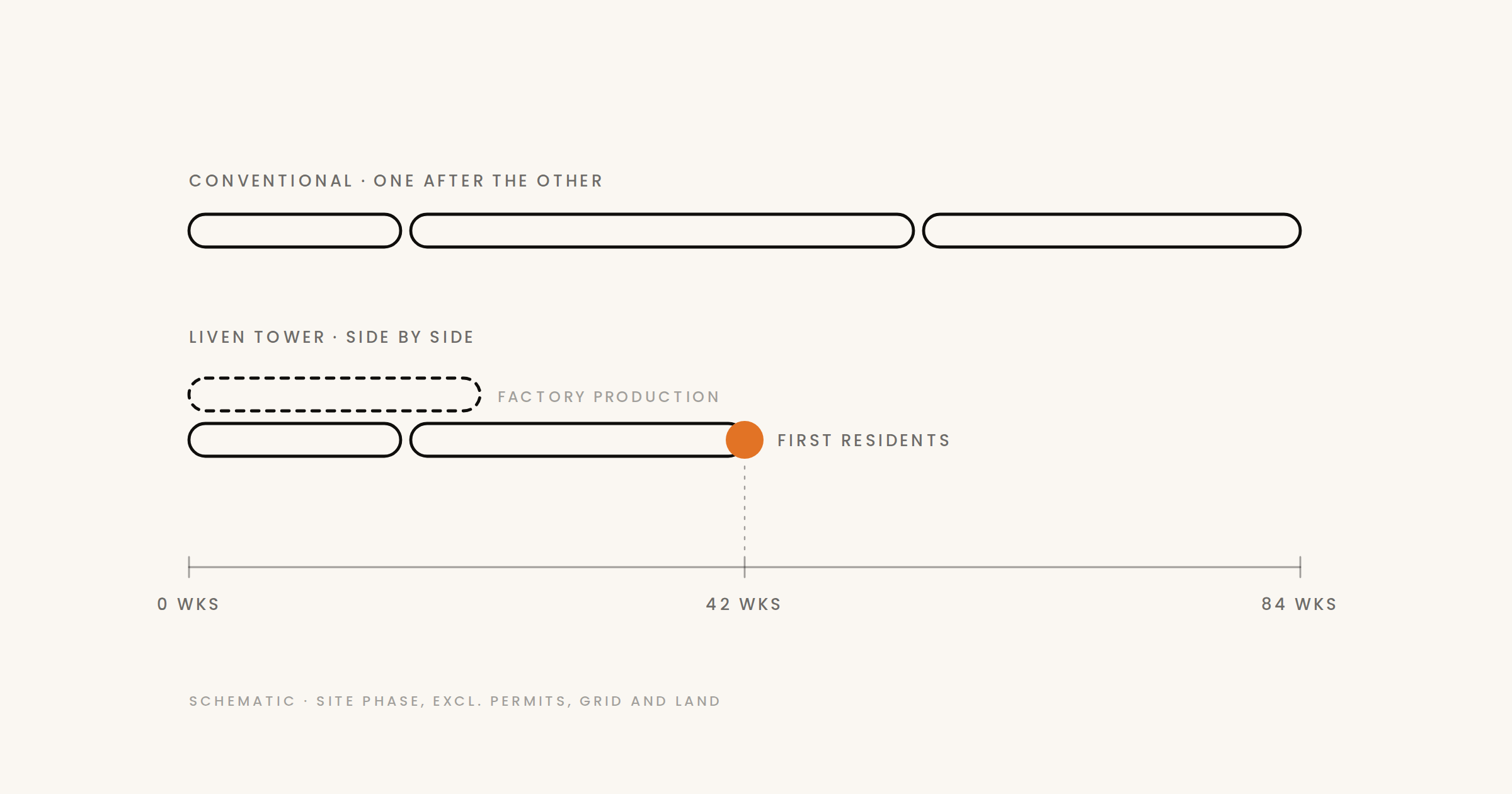
Without reservation, when it comes to speed. Liven Tower is built exactly this way. The homes are produced as complete modules by VDL De Meeuw while the foundation is laid on site. Two tracks run side by side instead of one after the other. That takes construction from roughly 84 weeks to roughly 42.
A factory delivers consistent quality and consistent dimensions, and everything can be checked before anything arrives on site. That is not a compromise on quality. Often it is an improvement.
But the factory makes the home, not the street
A factory is very good at making the same thing again. That is its strength. But the ground floor is exactly where every location is different. Who lives there. What the neighbourhood lacks. Whether there is a doctor, a place to work, somewhere to leave a bike, a reason to go outside.
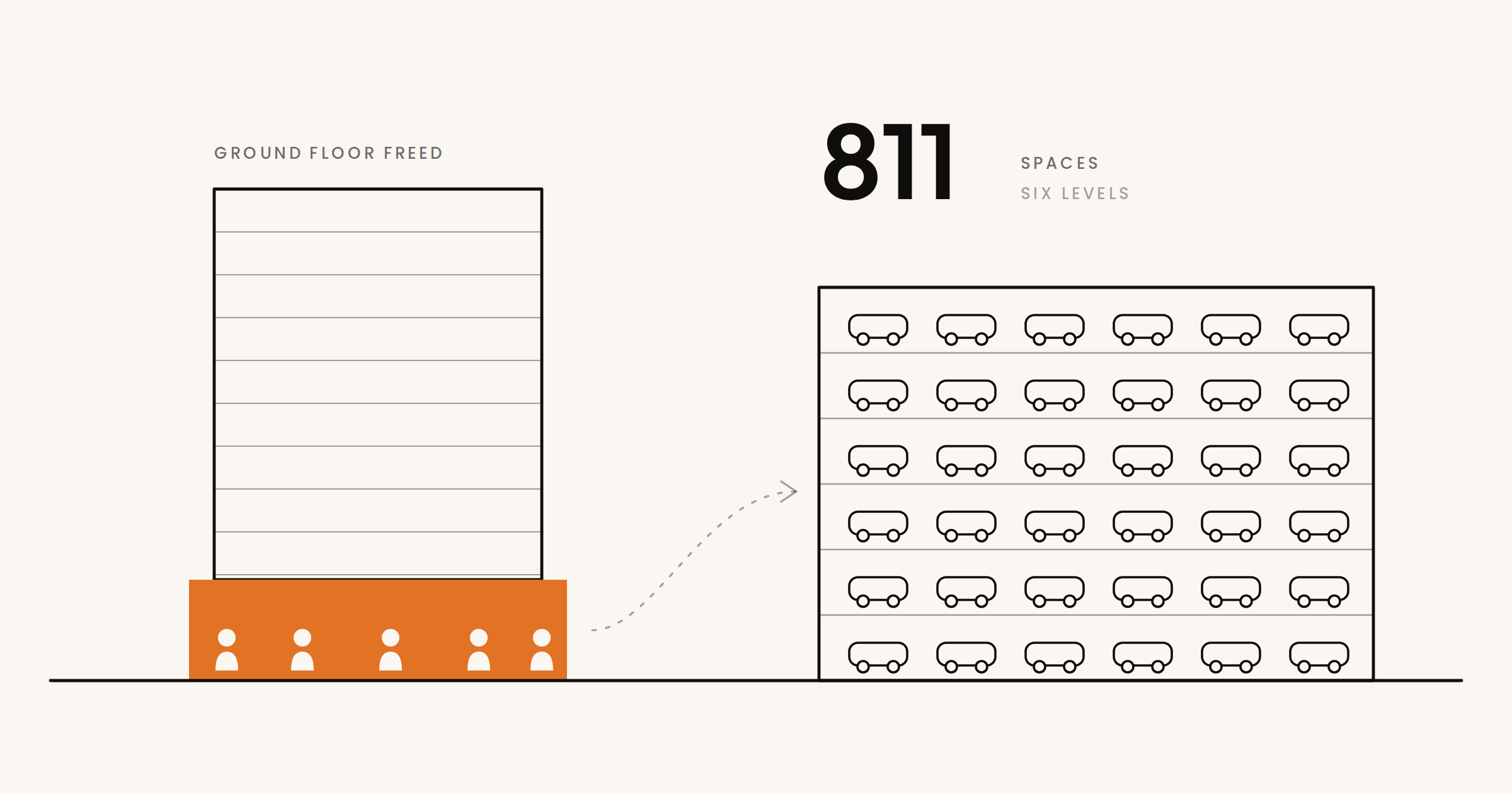
The risk of speeding up only the box is that we make the same mistake faster. Buildings with a car park at the bottom, a lobby with a wall of letterboxes and a blank facade facing the pavement. Thousands of new homes, and no neighbourhood.
Building faster without a plinth means building faster without a neighbourhood.
What we propose
Three things, to make the plan work even better.
Industrialise the plinth too. A ground floor can be thought of in modules as well. Our Plinth Configurator composes a plinth in eleven questions from 22 modules in four categories: care, mobility, encounter and technology. Repeatable in method, specific to the place.
Ask about the ground floor. Whoever counts how many homes come out of a factory can also ask what the ground floor of those buildings gives back to the street. A municipality that puts this in a tender gets better buildings in return.
Also accelerate what a factory cannot. Permits, grid connection and land remain the critical path. A factory can produce modules faster, but it cannot connect them any sooner to a congested power grid. The government is tackling permits. Grid congestion deserves the same urgency.
From the start
After Provada in June, Minister Boekholt-O'Sullivan wrote about our approach as "a system that takes technology, wellbeing, community and mobility into account from the start when designing residential buildings."
From the start is exactly the point. Half from the factory is a good goal. Let us make sure the street comes along from the start as well.